


 Every business begins the same way. Not with a website.
Not with a logo.
Not with a social media page.
Not even with a product. It begins with a name. Before a person can buy from a business, recommend it, search for it, trust it, or remember it, they need to know what it is called. A business has to be identified before it can be understood. That is where branding begins.
Every business begins the same way. Not with a website.
Not with a logo.
Not with a social media page.
Not even with a product. It begins with a name. Before a person can buy from a business, recommend it, search for it, trust it, or remember it, they need to know what it is called. A business has to be identified before it can be understood. That is where branding begins.
A lot of people treat branding like it starts with colors, slogans, fonts, or fancy design work. That is part of branding, but it is not the foundation. The foundation is identity. A business needs a name people can connect to, and in the modern world, that identity eventually needs a digital home.
That digital home is the domain.
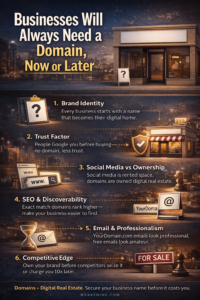
That is why businesses will always need a domain, whether they understand it on day one or learn it later after wasting time, money, and momentum.
A domain is no longer just a technical detail. It is not some extra feature you grab after everything else is set up. It is a core business asset. It is part of the brand itself. It shapes credibility, discoverability, control, and long term value. Businesses may try to delay that reality, but most of them end up learning the same lesson. Sooner or later, they need the right name online.
A Business Name Is the Beginning of the Entire Story
When somebody launches a business, they are doing more than creating an offer. They are creating a story in the mind of the public. People want to know who they are buying from. They want to know who is behind the product, who is behind the service, and whether the business is real.
That first impression almost always begins with a name.
The name gives the business shape. It gives people a way to talk about it, search for it, and remember it. Without a name, there is nothing to build around. With a weak name, growth becomes harder. With a confusing name, marketing becomes more expensive. With a strong name, everything else gets easier.
This is exactly why naming matters so much. A name is not just a label. It becomes the center of every future action.
It appears on:
business cards,
signage,
emails,
social media pages,
ads,
word of mouth referrals,
invoices,
contracts,
search results,
and eventually, the domain.
The moment a business name enters the world, the question of the domain begins to matter.
Branding Is Not Complete Until the Business Has a Digital Address
In the past, many businesses could get away with existing mostly offline. A local bakery could rely on foot traffic. A contractor could rely on referrals. A small store could survive from neighborhood exposure alone. That is no longer enough. Today, people search before they buy. They look before they trust. They compare before they commit. Even if a purchase happens offline, the decision often begins online. A customer hears the name of a company and immediately does one of a few things. They type the business name into Google. They search it on social media. They look for reviews. They look for a website. They want proof the business is real.
That is where the domain becomes critical.
A domain is the direct path to a business’s online identity. It is the place where customers expect to find the company. It acts like a digital storefront, but more than that, it acts like a statement. It says this business has planted its flag. It says this business exists beyond temporary apps and rented platforms. It says this business is serious enough to claim its space.
That matters.
A business without a proper domain often feels incomplete. Even if the company is legitimate, the absence of a clear domain can create doubt. People may not consciously explain it that way, but they feel it. A clean domain feels established. A messy one feels weaker. No domain at all feels like a missing piece.
Why People Need to Know Who They Are Buying From
Trust drives business.
A person does not just buy a service because it exists. They buy because they feel comfortable enough to move forward. They believe the company is real. They believe they can come back if there is a problem. They believe they are dealing with a real identity and not some fly by night operation.
That trust is tied heavily to branding.
Think about how people behave when they are considering a purchase. They do not simply ask what the product is. They ask who is selling it. They want context. They want a name. They want a source. They want a place to verify what they are seeing.
A domain helps answer all of that.
It gives the business an official home. It separates the brand from random listings, social accounts, and marketplace pages. It allows the company to present itself with consistency. The customer can go straight to the source instead of depending on third party platforms.
That is powerful because customers are tired of uncertainty. Online scams, fake pages, low quality sellers, and disposable businesses have trained people to be more cautious. A real domain is one of the simplest ways to reduce that friction.
When a customer sees a business operating on its own domain, it creates a different feeling. It feels more direct. More stable. More accountable.That feeling can be the difference between getting the sale and losing it.
Social Media Is Not a Replacement for a Domain
One of the biggest mistakes modern businesses make is assuming a social media page is enough.
It is not.
A social page can help visibility. It can help promotion. It can help engagement. It can help build audience. But it is not ownership. It is borrowed space.
A business that depends entirely on social media is building on land it does not control. Algorithms change. Reach drops. Accounts get flagged. Platforms lose popularity. Features disappear. Rules shift. Entire audiences can vanish from one platform to the next.
A domain does not have that weakness in the same way.
A domain belongs to the brand’s long term identity. It is portable. It can connect to a website, a landing page, a store, a newsletter, a booking system, an app, or future projects. It is flexible and durable. It becomes the anchor point that stays with the business even when trends shift around it.
This is why smart businesses eventually move toward domain ownership even if they start somewhere else. They realize they need a stable base. They need a place customers can always find them. They need something they can build around without asking permission from a third party platform.
Social media is promotion.
A domain is foundation.
Businesses that confuse the two usually pay for it later.
The Domain Is the Digital Equivalent of Location
For decades, physical business success depended heavily on location. Where you were positioned mattered. A good corner lot could change everything. A store on the right street could outperform a better business on the wrong street. Access, visibility, and memorability mattered in the physical world.
The same idea exists online.
A strong domain is a prime digital location.
It is easy to remember. Easy to type. Easy to share. Easy to brand. It makes the business easier to find and easier to trust. It reduces friction in marketing. It improves the effectiveness of word of mouth. It supports email professionalism. It makes the brand cleaner in ads, content, and outreach.
A weak domain does the opposite.
It creates confusion. It forces explanation. It leads to spelling mistakes. It weakens memorability. It leaks traffic. It makes the brand feel less polished.
People sometimes underestimate how important this is because a domain looks small on the surface. It is just words in a browser bar. But in reality, those words carry the entire weight of the business identity online. That is not small at all.
Businesses That Delay the Right Domain Usually Regret It
A lot of businesses do not secure the right domain in the beginning because they are focused on getting started quickly. They tell themselves they can fix the branding later. They pick a longer version of the name. They add extra words. They use odd spellings. They settle for a cheaper extension. They throw something together just to get moving.
Sometimes that works for a while.
But as the business grows, the cracks start to show.
Customers type the wrong address.
Emails get lost or look less professional.
Ads perform worse because the name looks clumsy.
Referrals do not convert as easily because the domain is not memorable.
The brand starts to feel bigger than the web address attached to it.
That is usually when the business realizes the domain matters far more than it thought.
So it goes back to try to acquire the better name.
That is where the pain begins.
Now the domain is taken.
Now an investor owns it.
Now another business owns it.
Now the price is far higher than it would have been earlier.
Now the company has to either overpay, rebrand, or continue operating with a weaker identity.
This happens every day.
Businesses that delay the domain often end up paying more later, either in money, opportunity, or brand confusion.
A Domain Is More Than a URL, It Is a Business Asset
Too many people still think of domains as cheap registrations instead of strategic assets. That mindset misses the bigger picture.
A good domain is an asset because it contributes to:
brand clarity,
customer trust,
marketing efficiency,
long term visibility,
email credibility,
search behavior,
and resale or acquisition value.
In some cases, the domain becomes one of the most valuable parts of the brand itself.
Look at how companies talk about owning their market position. They protect names. They acquire better domains. They rebrand around stronger digital identities. They spend heavily to remove friction from how customers find them.
Why?
Because a domain is not just a tool. It is a multiplier.
A strong domain can make an average brand look more serious.
A poor domain can make a legitimate business look weaker than it is.
A great domain can shorten the distance between curiosity and conversion.
That makes it an asset, not an afterthought.
Search Behavior Has Made Domains Even More Important
People do not interact with businesses the way they did twenty years ago. Search engines, mobile devices, and online comparison culture have changed expectations completely.
When someone hears about a business, they often search immediately.
They may type:
the business name,
the business name plus reviews,
the business name plus city,
the product plus the business name,
or simply try the domain directly.
If the business has a clear, relevant, professional domain, that helps reinforce the brand across all of those behaviors. It reduces uncertainty. It helps people match the name they heard with the business they are trying to find.
If the business has no clear domain or has a confusing one, things get messy. Users hesitate. Competitors gain ground. Search intent gets diluted. The business has to work harder just to be understood.
In an online environment where attention is limited and distraction is everywhere, that matters more than ever.
A business does not need unnecessary friction between hearing the name and finding the brand. A strong domain removes friction. That alone makes it valuable.
Exact Match, Brandable, and Category Defining Names All Matter
Not every business needs the exact same type of domain, but every business benefits from having a domain that fits its goals.
Some businesses benefit from exact match clarity. A domain that clearly describes the service or category can make the business instantly understandable. Others benefit from strong brandability. A unique name on a clean domain can help create a memorable identity that stands out from the crowd.
Some rare domains become category defining assets. These are the names that feel like they own the lane. When a business controls one of those, it gains a perception advantage that competitors cannot easily copy.
The point is not that every company needs the most expensive domain on earth. The point is that every company needs a domain that supports its identity rather than fighting against it.
That need never goes away.
It might be obvious on day one. It might become painfully obvious in year three. But eventually the business will feel it.
The Better the Business Gets, the More the Domain Matters
One of the most interesting things about domain value is that it often increases in importance as a business becomes more successful.
At the early stage, founders may think they can compromise. They tell themselves the product matters more. They assume customers will figure it out. They accept a weaker domain because they are focused on launching.
But once momentum starts building, the cost of weak branding becomes more visible.
A stronger domain can:
increase trust in outbound outreach,
make direct navigation easier,
improve ad recall,
support premium positioning,
clean up business cards and signage,
and strengthen investor or partner perception.
At a small scale, those advantages may seem minor. At a larger scale, they compound. That is why growing businesses often upgrade domains after realizing how much their existing one is holding them back.
Success does not reduce the need for a domain. It amplifies it.
Offline Businesses Still Need Domains Too
Some people still talk about domains as if they are only important for tech companies, startups, or online businesses. That is outdated thinking.
A local plumber needs a domain.
A real estate office needs a domain.
A church needs a domain.
A restaurant needs a domain.
A cleaning company needs a domain.
A landscaping business needs a domain.
A medical practice needs a domain.
A law office needs a domain.
Why?
Because people search everything.
They search hours, services, reviews, contact details, location, credibility, and proof. Even if the final transaction happens over the phone or in person, the online identity helps drive the decision.
Customers want reassurance before they call. They want to see something official. They want to know the company exists. A good domain supports that need.
This is why even traditional businesses eventually discover the importance of domains. The world changed around them, and customer behavior changed with it.
Domains Create Long Term Leverage
One of the most overlooked benefits of owning a solid domain is how much leverage it creates over time.
A business with the right domain can:
launch new services under the same brand,
build content around the same authority,
collect leads more efficiently,
operate professional email addresses,
run cleaner ad campaigns,
expand geographically,
and create a more durable identity.
The domain becomes the center point for future growth.
That is why a good domain often pays for itself many times over. Even if the upfront price feels painful, the long term leverage can easily justify it. A strong name helps the business move with more confidence and less friction for years.
That is not a small benefit. That is strategic advantage.
Why Domain Investors Understand This Before Many Businesses Do
Domain investors operate with a simple insight that many business owners only learn later.
Businesses need names.
Names need digital homes.
Digital homes gain value when they are clear, memorable, and aligned with demand.
That understanding is why domains get bought, held, sold, and developed. Investors are positioning themselves in front of future need. They know that even if a business does not realize the importance of a domain today, it may realize it tomorrow. That delayed realization is where so much value comes from.
This is not about tricking people or exploiting confusion. It is about recognizing the role domains play in branding and business infrastructure. Investors who understand branding, search behavior, trust, and market demand can spot digital assets that businesses will eventually want.
That is why the domain market continues to matter.
The Domain Market Is Still Full of Opportunity
Some people assume all worthwhile domains are gone. That thinking is shallow.
New businesses are launched every day.
New industries emerge every year.
Old sectors get reimagined.
New phrases become brandable.
New technologies create fresh naming demand.
Local markets still need strong digital identities.
Countless businesses still operate on weak domains and may upgrade later.
Opportunity still exists because business creation never stops.
As long as people continue starting companies, launching products, building services, and trying to stand out, domains will remain relevant. The internet may evolve, tools may change, and platforms may shift, but identity still needs an address. That reality keeps the domain market alive.
The Real Question Is Not If, It Is When
Most businesses will need a domain.
Some know it immediately and act fast.
Some realize it after they start marketing.
Some wait until customers cannot find them easily.
Some wait until they look less credible than competitors.
Some wait until growth exposes the weakness in their branding.
Some wait until they have to spend far more money acquiring the right one.
But the pattern remains the same.
The need comes.
That is why the real question is not whether a business will need a domain. The real question is when that need will become impossible to ignore.
Businesses will always need a domain, now or later, because businesses are built on identity, and identity has to live somewhere people can find it.
Since the beginning of business itself, naming has mattered. People need to know who they are buying from. They need a source, a signal, a point of trust. In the digital age, that signal increasingly runs through the domain.
A domain supports branding.
A domain supports trust.
A domain supports discovery.
A domain supports control.
A domain supports growth.
This is why the strongest businesses eventually care about the right one. It is why weak domains get replaced, why premium domains get acquired, and why domain investors continue to find opportunity in the market.
A business may delay the lesson, but it rarely escapes it.
Sooner or later, every serious brand wants a real home online.
And that home starts with the right domain.

